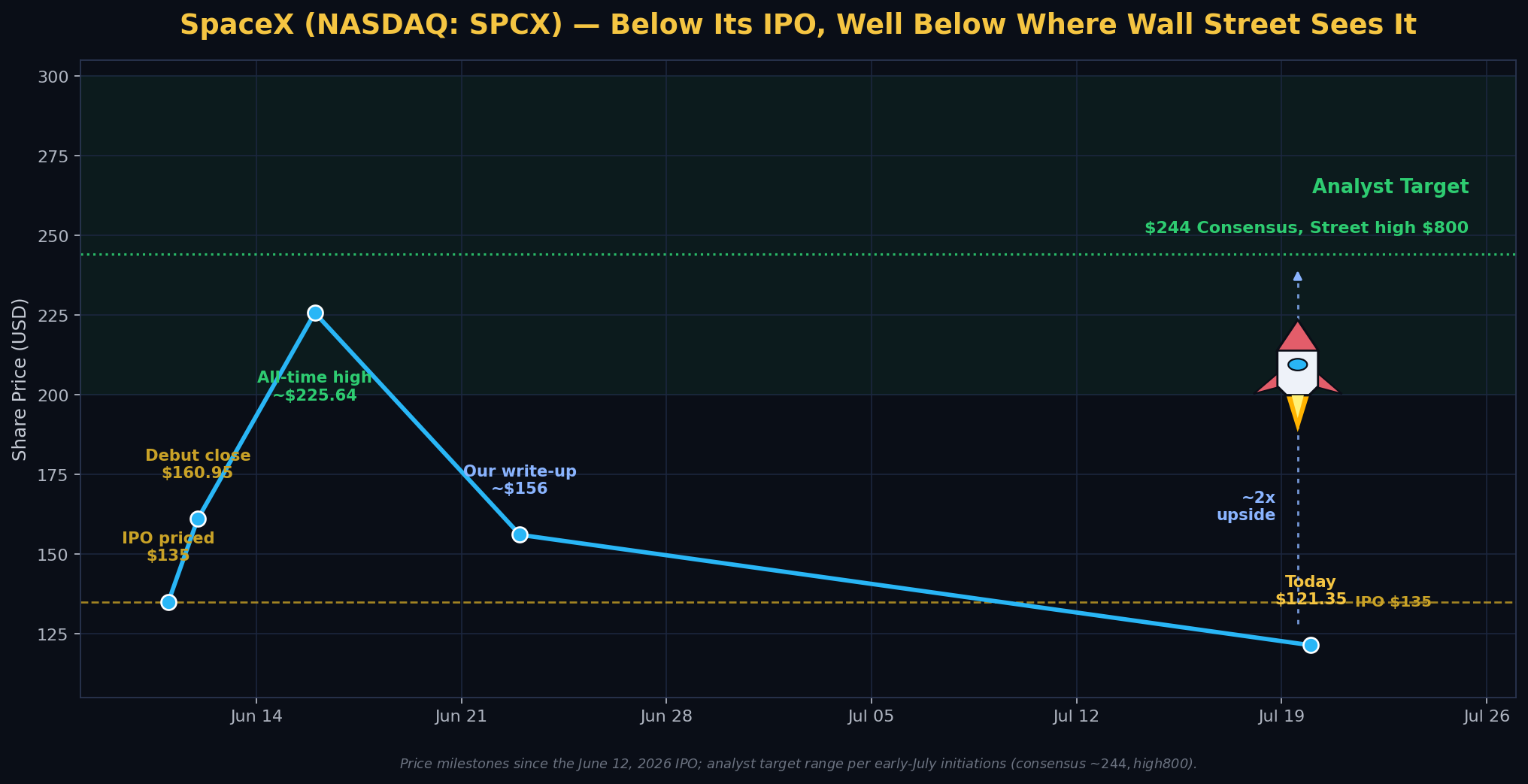
We are issuing a long-term buy recommendation for SpaceX (NASDAQ: SPCX) — a hold-for-years position, with our eyes wide open on the risks, which we lay out plainly below.
On June 12, 2026, Space Exploration Technologies Corp. completed the largest initial public offering in history. The company priced 555.6 million shares at $135.00 and raised roughly $75 billion — about two and a half times the previous record (Saudi Aramco, ~$29 billion) — at a valuation near $1.77 trillion. The stock opened at $150, closed its first day at $160.95, and within four trading sessions touched an all-time high of about $225.64, briefly making SpaceX the fourth-most-valuable public company on Earth, ahead of Amazon and Microsoft. On paper, it made Elon Musk the world’s first trillionaire.
Then the stock cooled off. SPCX fell more than 16% on Monday, June 22, briefly dipped below its $150 debut level intraday, and has since recovered into the $155–165 range (around $163 as we write) — still up more than 20% from the IPO price, but down roughly 28% from that first-week high. We’d caution readers not to over-read the headlines here: a sharp give-back after a record-setting debut is the normal behavior of nearly every mega-IPO once the opening euphoria fades, and much of the financial press reflexively frames anything connected to Elon Musk in the most negative light available. Nothing about the underlying business changed between June 16 and June 23. What that round trip really tells you is what kind of stock this is: a generational franchise wrapped in a brand-new, thinly-floated, extremely volatile ticker — which is exactly why entry discipline matters.
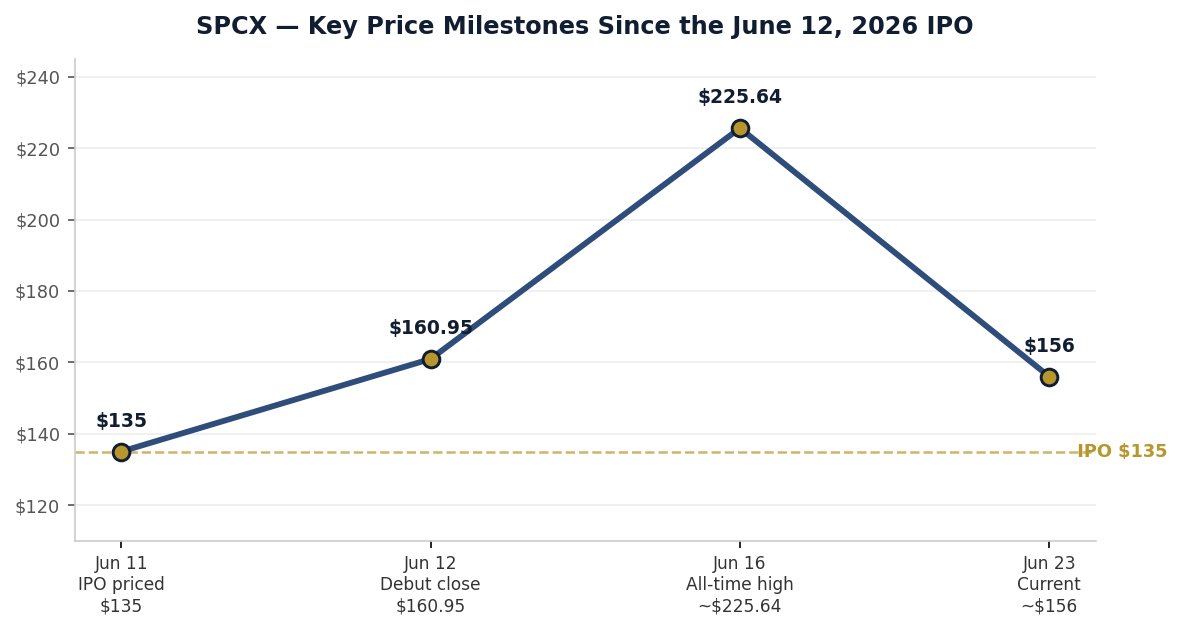
SPCX key price milestones from the June 12, 2026 IPO through June 23. The dashed line marks the $135 IPO price.
Why SPCX, Why Now — The Six Reasons
- Starlink is a real, profitable cash machine. The Connectivity segment did $11.4 billion in 2025 revenue (up ~50% year-over-year), at roughly 63% segment margins, and crossed 10.3 million subscribers across 164 countries. SpaceX operates an estimated 75–85% of all active satellites in low-Earth orbit. There is no real #2. This single business funds everything else the company does.
- It dominates launch like nothing in the history of the industry. SpaceX flew roughly 165–170 missions in 2025 — more than 80% of all mass humanity put into orbit that year — with a 99%+ success rate and reusable boosters, one of which has now flown 34 times. It carried 11 of 12 U.S. national-security launches and every U.S. crew and cargo mission to the Space Station.
- The growth option is Starship. The fully-reusable mega-rocket is progressing (a successful Indian Ocean splashdown in May 2026), with the next flight targeted for the July–August window and first commercial payloads aimed at the second half of 2026. If Starship works at scale, it unlocks next-gen Starlink, orbital compute, and lunar/Mars economics. (It is also the company’s #1 stated risk — see below.)
- Government and defense demand is locked in and growing. SpaceX reported a backlog of about $28.4 billion, anchored by NASA (including ~$4 billion of Artemis lunar-lander contracts), the Space Force, and the National Reconnaissance Office. This is sticky, multi-year, taxpayer-funded revenue.
- Index inclusion is coming. At a ~$2 trillion cap, SPCX is a near-certain addition to the major indexes within weeks of listing, which forces passive index funds to buy the stock regardless of price — a structural source of demand that did not exist before the IPO.
- A brand-new AI revenue engine. SpaceX is no longer just spending on AI — it is starting to sell it. The xAI merger handed it control of Colossus, one of the largest AI supercomputers in the world, and this week (the “SpaceX Strikes Data-Center Deal” headlines) the company signed open-source AI startup Reflection AI to lease Nvidia compute on Colossus for up to $6.3 billion — about $150 million a month from July 2026 through 2029. That is high-margin, recurring revenue that effectively turns on next month, on top of existing compute arrangements with other AI players and the pending acquisition of coding-AI company Cursor.
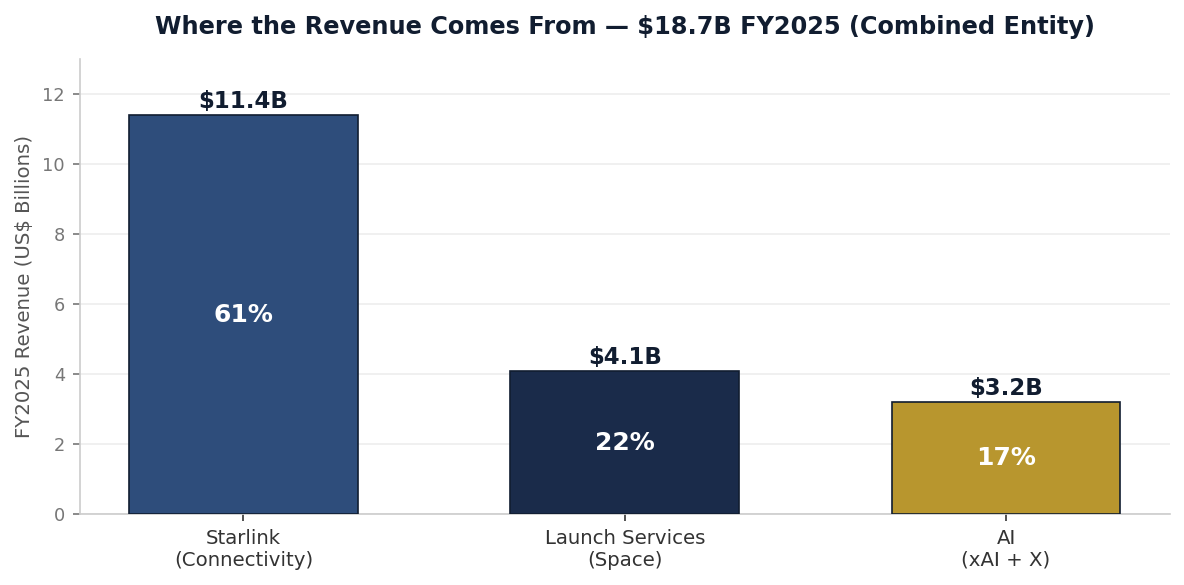
FY2025 revenue by segment. After absorbing xAI (owner of X) in February 2026, SpaceX now reports rockets, Starlink, and AI as one entity. The AI unit still loses money training its own models — but, as of this week, it is also a fast-growing revenue line (see below).
The Moonshot Inside the Moonshot — Data Centers in Space
And then there is the part almost no other company on Earth could even attempt. In January 2026, SpaceX filed with the FCC to operate up to one million solar-powered satellite data centers in low-Earth orbit, and unveiled “AI1,” an orbital compute craft wider than a Boeing 747 carrying roughly 150 kilowatts of AI hardware. The logic is elegant: the three bottlenecks now strangling AI on the ground — power, cooling, and land — largely disappear in orbit. Solar panels in space collect sunlight around the clock with no atmosphere and no nightfall; the vacuum is an effectively infinite heat sink; and there is no land, grid hookup, or water to fight over. The catch is that the whole idea only pencils out if you can launch racks of servers cheaply and often — which is to say, only if you own Starship and the world’s largest satellite network. SpaceX owns both. This is years away and unproven, and we are not paying for it today — but it is exactly the kind of uniquely-SpaceX optionality that is simply not available in any other stock on the market.
Straight From the Company
President & COO Gwynne Shotwell — the operator who has run SpaceX day-to-day for nearly two decades — set expectations for new shareholders in a CNBC interview from the Starbase factory floor on IPO day:
“I do not want to focus on quarterly earnings. I’m not saying we’re not going to do right by our investors, but what folks who invest in SpaceX need to know is that what we’re doing is very futuristic.”
That is the bull case and the warning label in a single sentence. You are not buying next quarter’s numbers. You are buying a decade-long bet on space infrastructure, satellite internet, and — now — artificial intelligence.
The Man Behind It
A word on Elon Musk, because with SpaceX you are unavoidably betting on him. Say what you will about his style — in our view he is, hands down, the most effective visionary and promoter in modern markets: a founder who can summon capital, talent, and the world’s attention toward an audacious goal like no one else alive. And he puts his money where his mouth is. The overwhelming majority of his wealth sits inside his own companies, and his roughly 6.4 billion SpaceX shares are locked up until June 2027 — a full year longer than everyone else’s — which means he is tied to exactly the same outcome as anyone who buys the stock here. That alignment, paired with a track record of doing things the experts swore were impossible (reusable orbital rockets, a profitable satellite-internet network, the best-selling car on the planet), is a real and underrated part of the bull case.
What Wall Street Is Saying
Here is the honest picture: the marquee research has not arrived yet. The IPO’s 22 underwriters — Goldman Sachs, Morgan Stanley, BofA, Citi, J.P. Morgan and others — are in their mandatory post-IPO “quiet period” and cannot publish ratings for several more weeks. The first independent initiation came from KeyBanc on June 22, which started SPCX at “Sector Weight” (neutral) with no price target, calling Starlink the key profitable-growth driver but warning that much of the upside “is already reflected in the stock’s valuation.” Early data-aggregator consensus is thin and noisy, with a wide range of twelve-month targets. We would treat any single price target on a two-week-old mega-cap with real skepticism — the real coverage, and the real debate, is still a few weeks away.
The One Caveat You Cannot Ignore — The Insider Lock-Up
This is the single most important thing for a new SPCX buyer to understand, and it is the reason we say “accumulate on weakness” rather than “buy it all today.”
Only about 4.2% of SpaceX’s shares were actually floated in the IPO. The other ~96% is held by insiders and early investors and is locked up — for now. Per 22V Research, the gates start opening soon: a 20% insider unlock after the company’s first earnings report in early-to-mid August; an additional 10% unlock that triggers if the stock trades 30% above the $135 IPO price; and further 7% tranches around August 21 and again on September 10. A standard 180-day lock-up frees the bulk of remaining shares on December 8, 2026, with Elon Musk’s own ~6.4 billion shares locked until June 2027. Translation: a large and rising wave of new sellable supply is coming all autumn. To be clear, this is a normal, fully-telegraphed IPO mechanic — not a red flag about the business — but supply is supply, and it argues for buying in pieces over time rather than chasing the price.
The Other Risks
- Valuation. At ~$2 trillion the stock trades at roughly 60–70x forward revenue. SpaceX lost about $2.6 billion at the operating line and $4.9 billion net in 2025. You are paying today for a 2030 outcome.
- Key-man risk. The prospectus itself flags that the loss of Elon Musk — who also runs Tesla, xAI, and other ventures and “does not devote his full time” to SpaceX — could significantly disrupt the company. His public statements can move the stock either direction.
- The xAI cash burn. The AI segment SpaceX absorbed in February 2026 burns on the order of $1 billion a month training its own models, and is the main reason the combined company is unprofitable today. The new compute-leasing deals (above) help offset that, but do not erase it. Bulls call it optionality; bears call it a cash drain bolted onto a rocket company.
- Governance. A dual-class structure leaves Musk with ~79–85% of the voting power. Public shareholders have little say. MSCI assigned the stock its lowest ESG rating (CCC).
- Competition. Amazon’s Project Kuiper in satellite broadband, plus Blue Origin and Rocket Lab in launch.
What Wall Street Profit Search Says
SpaceX is, in our view, one of the genuinely irreplaceable companies of this era — a near-monopoly in launch, the runaway leader in satellite internet, and the owner of the single most important growth program in aerospace. We do not say that lightly. But a great company and a great stock at any price are two different things, and SPCX arrives expensive, unprofitable on a combined basis, and saddled with a months-long parade of insider share unlocks.
One last note, on why we lean toward backing this one despite the price: this is not our first Elon Musk call. In October 2013, with Tesla trading around $170 a share, we told readers of this very letter that Tesla was “a $250 stock” — a long-term target Wall Street had not yet put its name to. Tesla hit it the following year. After Tesla’s two stock splits since (5-for-1 in 2020 and 3-for-1 in 2022, or 15-for-1 combined), that old $250 target works out to roughly $16.67 in today’s split-adjusted shares — and Tesla now trades north of $400, the equivalent of about $6,000 in 2013 stock. We mention it not to take a victory lap, but to explain why we give a Musk-led, vision-first company the benefit of the doubt even when the multiple looks impossible.
BUY / ACCUMULATE — a long-term buy. Buy now, then scale up: we would start a position at current levels rather than wait, size it as a high-risk-tier holding, treat the lock-up calendar (August through December) as a likely source of better add-on prices, and hold for years, not weeks. This is a story for patient capital that believes in the franchise — not a trade.
“Here’s exactly what I’ve been telling the friends and subscribers who have called and texted me asking what to do: buy whatever shares you can right around the IPO price, put a limit order in at $160 to add, and portion out your money so you always have dry powder to buy the dips. Don’t throw it all in at once — buy now, scale up, and let this volatile, thinly-floated stock come to you.”
— Dave Jones, Publisher, Wall Street Profit Search
Our key upcoming catalysts (and pressure points) to watch:
- July–August 2026 — next Starship test flight; first commercial Starship payloads targeted for H2 2026
- Early-to-mid August 2026 — first quarterly earnings as a public company and the first 20% insider lock-up unlock
- Around August 21 & September 10, 2026 — additional 7% lock-up tranches release
- Within weeks — expected addition to the major stock indexes (forced passive buying)
- December 8, 2026 — standard 180-day lock-up expiration (bulk of remaining shares)
If someone forwarded this letter to you and you want to subscribe to our market letter, just reply to contact@wallstreetprofitsearch.com with the word “subscribe” in the subject line, or go to wallstreetprofitsearch.com and sign up using the subscription form there.
Dave Jones
Publisher, Wall Street Profit Search.
Appendix
Key Terms — Plain English
A quick reference for the IPO and market terms used throughout this report. For broader market and trading vocabulary, see our full Glossary of Market Terms →
- IPO (Initial Public Offering)
- The first time a private company sells shares to the public and lists on a stock exchange. SpaceX’s was the largest ever by money raised.
- Float
- The portion of a company’s shares actually available for the public to trade. SpaceX floated only ~4.2% — a very small float, which makes the price more volatile.
- Lock-up period
- A window after an IPO during which insiders and early investors are contractually barred from selling. When a lock-up expires, a wave of new shares can hit the market and push the price down.
- Greenshoe (over-allotment)
- An option that lets underwriters sell extra shares (here, up to 83.3 million more) if demand is strong.
- Underwriter
- The investment banks (Goldman Sachs, Morgan Stanley, etc.) that organize and sell an IPO. After the deal they observe a “quiet period” before publishing research.
- Quiet period
- A regulatory window after an IPO during which the underwriting banks cannot publish ratings or price targets on the stock.
- Market capitalization (market cap)
- The total value of all a company’s shares — share price times shares outstanding. SpaceX’s is around $2 trillion.
- ARPU
- Average Revenue Per User — how much a subscriber pays on average. Starlink’s ARPU is falling as it adds cheaper plans in more countries.
- EBITDA
- Earnings before interest, taxes, depreciation and amortization — a rough proxy for a business’s operating cash profit.
- Backlog
- Contracted future revenue that has been signed but not yet delivered. SpaceX reported about $28.4 billion.
- Dual-class shares
- A structure with two types of stock where insiders hold super-voting shares. It lets Elon Musk keep ~79–85% voting control while owning far less than that economically.
- Key-man risk
- The danger that a company depends so heavily on one person that their departure would seriously damage it.
- Index inclusion
- When a stock is added to a major index (like the S&P 500), index funds that track it are forced to buy the stock — a source of demand independent of the company’s results.
- Price target
- An analyst’s projected share price, usually twelve months out.
- Dilution
- What happens to existing shareholders when more shares enter the market — each holder owns a smaller slice. Lock-up expirations are a common source.
IMPORTANT DISCLOSURE